Saturday, 31 October 2026

Ghost Wall by Sarah Moss, Audiobook narration by Christine Hewitt

Ghost WallGhost Wall by Sarah Moss
My rating: 4 of 5 stars

A member of my in person book group recommended this writer to me. Coincidentally I noticed that the editor of this book was Max Porter , who I have been reading and raving about recently, during his time at Granta.
Sarah Moss 's Ghost Wall has an unusual setting , Northumberland more, for an all to common issue, male domestic violence. its 150 pages are told in the voice of teenager Silvie who, with her mother and father , is on a experimental archeology trip to experience Iron Age life with an anthropology Professor and his students. Her father is a bus driver, self-taught and downright authoritarian , lording it over mother and daughter. While the students treat the exercise at the most semi-seriously, the father is fanatical, looking for authenticity and his 'British' roots. His Northern family are well used to camping and foraging in contrast to the students who skip off to the Local Spar for groceries, and in the case of one student Molly, a hot shower and the pub in the village. The tension is thus set and is escalated in the story. Silvie's stream of consciousness narration which is present for most of the book is gripping. The reader see her change from a youngster, happily walking with her dad on the moors, to an abused teenager and to cult victim in a almost 'Lord of the Flies' climax. It is unsettling yet superb. Sparse yet horrifically gripping. Character full, very filmic yet uniquely absorbing. Beautifully narrated by Christine Hewitt

View all my reviews

Friday, 30 October 2026

The Eye of Goliath by Diego Muzzi, translated by Rahul Bery.

The Eye of GoliathThe Eye of Goliath by Diego Muzzio
My rating: 4 of 5 stars

Phenomenal book. Gothic psychological horror which begins with quotes from RLS's The Strange Case of Dr. Jekyll and Mr. Hyde and Other Tales of Terror, and which starts with RLS's cousin David Alan Stevenson arriving with a patient at the doors of a post WW1 sanatorium just outside of Edinburgh where the first and final, third, chapters of the book take place and which is managed by Dr Edward Pierce, a proponent of hypnosis as treatment as against the established Germanic school of psychiatry's treatments and protocols.
The patient is lighthouse Engineer David Bradley, whose diary forms the middle part of the book. Bradley had been set to assess lighthouses in southern Argentina and ended up being left alone with limited provisions on the Eye of Goliath lighthouse of Ushuaia, when his return boat was delayed by bad weather and where haunted by the story of its previous occupant murderer and taxidermist, Juan Evans, his mental state deteriorates to such an extent that he becomes delusional and a bit unhinged.
Both Bradley and Pierce had served in the trenches of WW1 and the novel is set at that notorious time when electrotherapy was used to 'cure' various psychoses. This book investigates the impact of war on people's psyche , how no one ever comes back from war unchanged and the various ways that dual personalities a la Jekyll and Hyde can be manifest.
The novel is comparatively short at 188 pages but punch way above its weight. It is a very well constructed novel, the detailed layering and linkage between the men and the chapters is exceedingly well done. I know horror is not everyone's genre but in my opinion this book is so well written that it is worth putting any bias aside and looking at it as a psychological treatise.
I will most definitely be looking forward to more of Diego Muzzio's books to be translated, Pushkin Press website gives a minimal bio as does the Royal Literary Fund site for translator Rahul Bery who I suspect is one to follow too.
Highly recommended.

View all my reviews

Wednesday, 14 October 2026

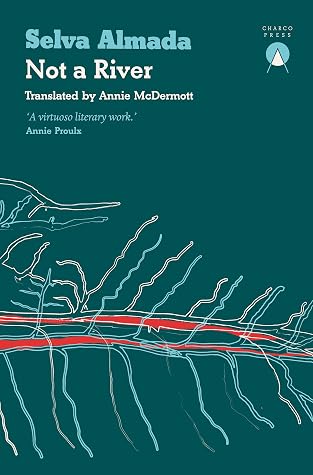
Not a River by Selva Almada, transl by Annie McDermott (4*)

Book Cover

Shortlisted for the 2024 International Booker and translated by Annie McDermott I've been wanting to read this since the English Translation came out . Also on my to be read list are her other books The Wind that Lays Waste and Bricklayers and although these are the first of this loosely connected trilogy I've always been under the impression they can be read in any order. In the UK it is published by the marvelous Charco Press from Edinburgh who produce the great Central and South American Literature in English. This edition includes a post note by the translator which is well worth a read. She was shortlisted also for Brickmakers.

This is a story of a weekend island fishing trip by 3 friends, which echoes a previous trip made some years before. Almada works her storylines back and forth, flowing like a river, and rivers we know can be smooth and steady, welcoming and also dangerous fierce raging torrents. So with this book. I read that the author was born and raised in Entre Rios which is a province to the north of Buenos Aires that is full of rivers dotted with lush islands. You feel that tension between water and land, between island and mainland in this book as Almada explore classic topics such as the bonds of friendship and family, the dangers facing women and girls, and the male urge to solve problems through violence.

One group consists of the fishermen from the mainland Enero and El negro and the younger Tilo, son of their friend Diana and now taking his father Eusabio's place in the fishing group. The islander group is led by Aguirre, his sister Siomara and her daughters Lucy and Mariela. Their backstories lap upon the reader as short sentences, short paragraphs as waves on the page. It is a beautifully constructed story, has an ease of reading, a great build up of tension and grand storytelling in under 100 pages.