Showing posts with label Indian Literature. Show all posts

Sunday, 27 July 2025

Book Review : The Wildings - Part 1: The Wildings and Part 2: The Hundred Names of Darkness by Nilanjana Roy , narrated by Tania Rodrigues

The Wildings (The Wildings, #1)The Wildings by Nilanjana Roy
4 of 5 stars

Utterly marvellous tale of a colony of cats in Old Delhi. For story lovers of all ages. Highly recommended.

Linguistic note - the squirrels are named Ao and Jao - Come and Go.
The birds are called sa, re, ga, ma, pa, dha, and ni - the 7 notes (swara) in Hindustani classical music.


The Hundred Names of Darkness (The Wildings, #2)The Hundred Names of Darkness by Nilanjana Roy
My rating: 4 of 5 stars

No sequel disappointment herein! The adventures of the Nizamuddin cats continues as they struggle through hard times.
Marvelous section telling of the love between the two eagles,Tooth and Claw.
The author's choice of names for all the animal characters is great, and the tone of voice captures their individual characters so well.
Both books are so very well narrated by Tania Rodrigues.

I can't recommend these enough!

View all my reviews

Friday, 11 July 2025

Book Review: Blackwater by Nilanajana Roy

Black RiverBlack River by Nilanjana Roy
My rating: 4 of 5 stars

Although the plot is a bit predictable in the sense that I guessed the murderer really early on, that didn't detract from a good read - the main characters' back stories are the best part eg Chand's time working in Delhi and living on the back waters with Rabia and her husband. What is also very strong is the representation within the story of the societal issues in India - Hindi v Muslim, city growth and expansion, climate and environment issues, corruption, police violence and the difficulties that woman in particular face.

The author has fairly recently started writing for the FT and is on the panel selecting 2026 International Booker. This is her first adult novel, so a really good debut in my opinion. She has previously written two children's books. Additionally, I'm dipping in and out of her book of essays The Girl Who Ate Books: Adventures in Reading

View all my reviews

Saturday, 3 February 2018

Review: Chekov and Zulu by Salman Rushdie

At the Auction of the Ruby SlippersThis story can be found online at https://www.newyorker.com/magazine/1994/08/22/chekov-and-zulu


All I can say about this one is that it is a pseudo spy story which is constructed via a fantastic merger of western pop culture by using Chekov and Sulu two characters from the sci-fi series Star Trek as inspirational nicknames for two Indian residents in the UK during the time of the assassinations of Indira Gandhi and then Rajiv Gandhi. The story shows the friendship between old school friends now working within the Indian Secret Service The choice of names reflects how they see themselves "not the leaders....but the ultimate professional servants". But their friendships is put under strain following the assassination of Indira Gandhi by her two Sikh bodyguards following the Indian State's attack on the Sikh Golden Temple at Amritsar. They never meet again. One resigns, returns to Bombay to work in private security and lives out a good, prosperous life; the other continues to work in his diplomatic position in London unable, unwilling to take a stance on terrorism. Ultimately this becomes his downfall as he is caught up in the assassination of Rajiv Gandhi by Tamil Tigers some years later. "The tragedy is not how one dies. It is how one has lived"

I read this story as part of Salman Rushdie's short story collection East, West. My Book Review

ashramblings verdict 4* Very, very clever. Whether it is too clever may depend on your knowledge of both Star Trek and Indian history.

Wednesday, 17 January 2018

Review: At the Auction of the Ruby Slippers by Salman Rushdie

My rating: 3 of 5 stars

This story is available online at Granta Magazine . I always have a hard time when reading satire and this appears to be one. I read it as a futuristic nightmare based around the auction of said slippers. The slippers presumably refer to those from The Wizard of Oz, and the story is a satire on consumerism, the free market economy gone mad where everything is for sale. Further than that I was completely lost on a first read.

The best explanation of this story I have read is by ROBERT COOVER in Nwe York Times and I quote -
"the story is a broad sociopolitical satire, a bit over the top at times, told by a communal "we" and depicting the current market-based free-for-all as a brutal futuristic hell wherein everything in the world is for sale, with the hoarding of possessions leading to universal paranoia: "These are uncompromising times," the narrator says.
Uncompromising times: Ayatollah Khomeini issued his notorious fatwa against Salman Rushdie on St. Valentine's Day 1989, and throughout the nearly six years since then Mr. Rushdie, a target not only of religious zealots but of professional killers hired by ecclesiastical thugs and heads of state, has remained in virtual exile from his national and literary communities -- indeed in virtual imprisonment, managing only occasional dramatic appearances on the world stage to plead his unique and desperate case.
"At the Auction of the Ruby Slippers" thus speaks directly to the author's own consequent dread of the bunker mentality, and to his fear of a world market economy that tolerates the intolerant, since it's all good for business (and it does so by way of a central metaphor close to his own heart as a writer).
THIS story was originally published along with an essay, "A Short Tale About Magic," in a small British Film Institute book as a kind of accompaniment to the film "The Wizard of Oz," which Mr. Rushdie describes as his "first literary influence" at the age of 10: "When I first saw the 'The Wizard of Oz' it made a writer of me." It was also his model during the writing of his remarkably cheerful post-fatwa novel "Haroun and the Sea of Stories" (1990): "Of all movies, the one that helped me most to find the right voice for 'Haroun' was 'The Wizard of Oz.' The film's traces are there in the text, plain to see; in Haroun's companions there are clear echoes of the friends who danced with Dorothy down the Yellow Brick Road."
Late in "At the Auction of the Ruby Slippers," there is a moment when the harsh impersonal satire shifts abruptly and somewhat discordantly into a first-person-singular account of a frustrated love affair between the narrator and his cousin Gale, who is lost to an imaginary and clearly uncivil lover who has escaped from a caveman movie. Gale, of course, is Dorothy's surname in "The Wizard of Oz," and as his loving cousin she liked to cry out during sex: "Home, boy! Home, baby, yes -- you've come home!" The narrator keeps a portrait of her "in the guise of a tornado."

HE sees her in a bar watching a television report about a spaceman stranded forever on Mars, showing "his slow descent into despair, his low-gravity, weight-reduced death" while he sings a medley of old songs, including several from "The Wizard of Oz." The narrator wants to buy Gale the auctioned ruby slippers (the universal reverence for them, he suggests, is due to "their affirmation of a lost state of normalcy") so she can go to Mars and bring back the spaceman, with whom he clearly identifies: "Perhaps I might even click the heels together three times, and win back her heart by murmuring, in soft reminder of our wasted love, There's no place like home." He has not only been left to waste away in enforced solitude on an inhospitable planet, he has also been threatened, in these uncivil times, with the loss of his most precious love, his hope, his "Over the Rainbow" muse. "

I read this story as part of Salman Rushdie's short story collection East, West. My Book Review

Review: Yorick by Salman Rushdie

My rating: 2 of 5 stars

This story is available online at http://www.unz.org/Pub/Encounter-1982... .
I like it when reading to stumble across a previously unknown word to add to my vocabulary, but when this happens multiple times in a story, my readerships suffers - this is what happened in this reworking based on teh story of Hamlet, and I'm not just talking about unusual words but the very rarely seen variety eg "terigversation" which the dictionary defines as (1) "an evasion of straightforward action or clear-cut statement, an equivocation" and (2) a desertion of a cause, position, party, or faith. Compound this with Rushdie trying to combine writing as per Shakespeare with a modernism narrator, this makes for a jolly complicated read which lost me. Yes, some bits are very clever, but for me his reworking didn't come off and more's the pity, because this is an ambitious piece of writing, one which I have no doubt the literary critics and academics will have a field day with, but one which I fear would be too confusing and thereby too challenging a read for readers unfamiliar with Shakespeare's Story and style.

I read this as part of Salman Rushdie's short story collection East, West My Book Review

View all my reviews

Review: The Prophet's Hair by Salman Rushdie

The Prophet's Hair The Prophet's Hair by Salman Rushdie
My rating: 4 of 5 stars

This story is available online at https://www.lrb.co.uk/v03/n07/salman-... . I read somewhere that the inspiration for this story is that the real life Prophet's Hair relic kept at Hazratbal Mosque in Srinagar, Kashmir went missing in December 1963 and was retrieved about two weeks later.

While Rushdie's overly long sentances irritate me, this story is a beautiful example of storytelling, full of comedic tragedy, worthy of incorporation in 1001 Nights. Its core story is timeless, and would make a great oral rendition to adults and children alike. It is a moralistic fairy tale in which the theft of a religious relic brings catastrophe upon the greedy.

Hashim, the moneylender, is a collector of fine things. One day he finds a vial floating in the water. It contains a silver pendant bearing a single strand of human hair. It is the Prophet's Hair, stolen only the previous day from the Hazratbal mosque. However, the relic is cursed and it transforms the moneylender, changing his behaviour to such an extent that his family are very concerned. His son Atta and daughter Huma plan to remove the relic from thier father's possession. The 'Thief of Thieves' Shiekh Sín is hired to burglar their house and steal it from their father in return for Huma and her mother's jewelry.

Needless to say things do not go as planned. The curse reigns havoc and the members of both Hashim and Sín's families are affected by the relic's curse, but not all as not as deleteriously as one might expect! Some receiving just deserts and others some quiet surprising justice.

I read this story as part of Salman Rushdie's short story collection East, West. My Book Review

View all my reviews

Review: Good Advice Is Rarer than Rubies by Salman Rushdie

My rating: 4 of 5 stars

This story is also available in the New Yorker magazine - Miss Rehana is accosted by so called advice expert Muhammad Ali as she joins the Tuesday line of women seeking British visas at the Consulate. He is beguiled by her beauty but sees her as an easy target for his scam as she is without a male chaperone. She tries to shrug him of claiming poverty and does not succumb even to his offer of a British passport he has "acquired". The twist is when she returns to him after failing the questions at the interview. He cannot understand why she is happy. All is revealed. All was not as it had seemed. I didn't see it coming :)

This story is part of Salman Rushdie's short story collection East, West. My Book Review

View all my reviews

Sunday, 27 February 2011

Deep River by Shusaku Endo

part of my Indian Literature series

The author 

Shusaku Endo (1923 – 1996) was a highly acclaimed Japanese novelist who belonged to the Christian faith and was therefore in a member of a minority in Japan. His writings are all a vehicle for his faith, but even if you are not a believer, his writings in my opinion are always compelling reads, touching pieces of great sincerity and insight into the human condition.

The Book

Deep River (1993) by Shusako Endo


My Review

Just as tributaries of a river converge into one , so Endo brings together the spiritual journeys of 4 Japanese tourists as they undertake a tour of India in the last days of the reign of Indira Gandhi.

Numada grew up as a boy in Japanese occupied Manchuria until his parents separation meant his return to Japan. His boyhood love for the puppy he had to leave behind turns him into a writer of stories in which children communicate with animals. In later life he survives heart stopping surgery at the same time as his beloved minor bird dies. SPOLIER - His visit to India culminates in him buying and freeing a minor bird there in gratitude

Kikuchi’s story of how he survives WW2 retreat of the Japanese Army from Burma along the Road of Death thanks only to the actions of a comrade in arms makes quite an impact on the reader. In a mistaken understanding that India is mainly Buddhist, he wants to perform some Buddhist rituals for his fallen comrades and for their enemies because this comrade’s actions had haunted the comrade all his life, leading to alcohol abuse, hospitalization and his eventual death. But not before he received comfort from a European Christian volunteer at the hospital.

Izube’s wife has recently died of cancer. He’s a typical middle class Japanese manager. Throughout his marriage ha has taken his wife for granted and is surprised by her passionate deathbed plea that he re-find her when she is reborn It is this search that takes him to India. His search takes him to remote Indian villages, beggar children and fortune telling charlatans.

Mitsuko thinks she is incapable of loving another. At college she rebelled and led a wild life and now has a failed marriage behind her. At collage she goaded on a young naive boy, Otsu, who she seduces. Otsu is deeply religious and Mitsuko tries to break his attachment to his faith. She fails and he enters the training for the priesthood in France. She encounters him again there during her own honeymoon, and again years later in Varanasi on her India trip. He has been flung out of the seminary for his radical belief in an Asian Christianity but is still strong in his faith and works to ferry the bodies of the dead who have no money to the river and the still living, but dying to the free guest houses of the town where Hindus come for rebirth.

SPOILER - Their stories are tied together by the trip, which comes to its finale through the silly actions of their fellow traveller Sanjo, a young photographer. With backdrop of the murder of Indira Gandhi by her Sikh bodyguards, the tensions of multiple faiths, languages and cultures clash in India itself and within the tourist group. By their actual journey and their spiritual one, each of the book’s characters confront the ambiguities that are Indian culture, its castes and its religious believes, its perception that good and evil are intimately intertwined just as the dead bodies flowing in the Ganges are part and parcel of the same belief system that has people washing on its banks in the hope of rebirth. Each character in their own way finds a moment of epiphany along the banks of the sacred river.

A satisfyingly spiritual read.

Sunday, 16 January 2011

More Tagore

part of my series on Indian Literature

I  am becoming absolutely enthralled by the writing of Rabindranath Tagore. It is having much the same effect on me as reading  Pablo Coelho when I first encountered him.

My slow tasting of his The Crescent Moon continues. I have just read a half dozen or so passages which I most ardently recommend any parent to read. They simply ooze parental love.  Here is just one.

Father and son Photo: Bozo fisherman and child, Mali 2006.
When and Why
WHEN I bring you coloured toys, my child, I understand why there is such a play of colours on clouds, on water, and why flowers are painted in tints--when I give coloured toys to you, my child.
When I sing to make you dance, I truly know why there is music in leaves, and why waves send their chorus of voices to the heart of the listening earth--when I sing to make you dance.
When I bring sweet things to your greedy hands, I know why there is honey in the cup of the flower, and why fruits are secretly filled with sweet juice--when I bring sweet things to your greedy hands.
When I kiss your face to make you smile, my darling, I surely understand what pleasure streams from the sky in morning light, and what delight the summer breeze brings to my body--when I kiss you to make you smile.


I just love the way he uses nature to explain love – the simple, spiritual ties that bind Man to Earth, parent to child.

Friday, 7 January 2011

The Night After Retirement by Kanuparthi Varalakshamma

 part of my series on Indian Literature
SaraswatiThose of us in India I am sure have come across many job’s worth folks wielding power from official positions. I’ve just read this short story about one such man’s transformation and am left wondering does it ever happen like it is portrayed there?
First a bit of background. I stumbled across Literary Voices of India who produce translations of contemporary Indian writing. They say,
“The works of regional Indian writers differ considerably from those of Indian writers in English. The latter have an urban sensibility rooted in the norms of the educated class in India. Local writers, on the other hand, speak in a raw, visceral voice of a world left behind by modernity and the struggle to conquer the most basic challenges of daily life.”

The story

On their current welcome page were links to 3 short stories, I just picked one at random,
The Night After Retirement by Kanuparthi Varalakshamma

The author

All I have gleaned about the author is that she was from Orissa, wrote in either or both Oriya and Telugu, and lived 1896-1960 and was a playwright and short story writer.

My Review

It is the story of deputy collector Rao’s last day in office and his first night as a retiree. Much of his sense of loss could be felt by anyone on the brink of retirement,  but much is specifically Indian – the loss of all his trappings of position and power, his car, his office, his house, his servants, and his punkahwalla.  I am also struck by his and his family’s lack of planning for this inevitable day – again fairly typical, in my experience of India. As he daydreams about the patriot he sent ruthlessly to prison due for release on the same day, I  wonder about analogies to Pontius Pilate. His wife, seems to be  more of a realist, and I loved her dismissal at the end, I could just hear her tone of voice!

Verdict

I leave you to judge whether her writing is in the “raw, visceral voice of a world left behind by modernity” that the site claims, but I shall say I found her portrayal of this man to ring true.
Picture: Saraswati, the Hindu goddess of knowledge, music and the arts

Monday, 27 December 2010

‘the sunset was hiding its last gold like a miser’

part of my series on Indian Literature
One cannot really come to India and not read its literature. And one cannot say one has read its literature without reading Rabindranath Tagore, for that would be like visiting England without seeing a Shakespeare play, without reading Dickens; travelling to Scotland without reading the poetry of Robert Burns, or the novels of Robert Louis Stevenson or Sir Walter Scott.
Rabindranath Tagore (1861-1941) won the Nobel Prize for Literature in 1913, the first Asian author to do  so. He was primarily a poet, although he also wrote essays, short stories, novels, plays, musical dramas, and painted. Perhaps his most well known works are Gitanjali  / Song Offerings (1910), The Gardener (1913), The Fugitive (1921) and Ghare-Baire / The Home and the World, (1916)  which was probably the only one I had ever heard of prior to researching Indian literature. He wrote in Bengali, so I must read him in translation and that, as I understand it, is plagued by lack of correspondence between his Bengali original volumes and the English translations. Infuriating, but that’s the situation.  Now his work is readily available on the web, and English translations are available at Project Gutenberg.


So this week I made a start on Tagore. I’d downloaded a few of his works from Project Gutenberg before I came to India  but hadn’t really looked at them until now. I sat down on Boxing Day over a cup of tea to peruse them with a view to selecting something to read once I had finished the novel which is currently underway.  Wow!  Just 30 minutes spent dipping in and I am blown away.  Even on reading just a few pages, I am immediately struck by the level of emotion in his work (he writes from the heart) and his incredible use of language ( he is a painter with words) and I am reminded of the work of Pablo Neruda . 
Here is the opening poem of his collection The Crescent Moon
THE HOME
I paced alone on the road across the field while the sunset was hiding its last gold like a miser.
The daylight sank deeper and deeper into the darkness, and the widowed land, whose harvest had been reaped, lay silent.
Suddenly a boy's shrill voice rose into the sky.  He traversed the dark unseen, leaving the track of his song across the hush of the evening.
His village home lay there at the end of the waste land, beyond the sugar-cane field, hidden among the shadows of the banana and the slender areca palm, the cocoa-nut and the dark green jack-fruit trees.
I stopped for a moment in my lonely way under the starlight, and saw spread before me the darkened earth surrounding with her arms countless homes furnished with cradles and beds, mothers' hearts and evening lamps, and young lives glad with a gladness that knows nothing of its value for the world.
If I had a set of paint brushes I feel I could paint this scene, it is so real. Have you ever read something as beautiful as ‘the sunset was hiding its last gold like a miser’ ? You can see it can’t you? That colourful ball being squeezed on the horizon, the sky holding onto the last drop of colour before the black of night.
Or ‘leaving the track of his song across the hush of the evening’ You can hear the boy’s shout shatter the silent solitude of the stroll, stopping him in his tracks to see the ‘countless homes’ of the village ‘beyond the sugar-cane field’

Friday, 24 December 2010

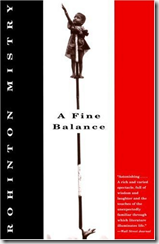
A Fine Balance by Rohinton Mistry

part of my series on Indian Literature
image The Author
Rohinton Mistry, born Bombay/Mumbai, now  living in Canada, is one of the many Indian diaspora writers writing in English.  He has authored 5 books –
  • Such a Long Journey   Faber and Faber, 1991
  • Tales from Firozsha Baag   Faber and Faber, 1992
  • A Fine Balance   Faber and Faber, 1996
  • Family Matters   Faber and Faber, 2002
  • The Scream   McClelland & Stewart, 2008
He does not have a website and does not often give interviews, but as has been reported by Times of India he  has been unusually vocal recently following the banning of his book Such a Long Journey at Mumbai University following allegations by Shiv Sena that the book contained derogatory remarks about Maharashtrians.
Author photo courtesy of Faber and Faber website.
The Bookimage
A Fine Balance
During 1975 amidst the  State of Emergency, Farsi widow Dina is trying desperately to avoid her brother’s attempts at making a second marriage for her. In an attempt to earn an independent living she takes in a student lodger, Maneck, and begins a tailoring business, illegally, from her flat with two Hindu tailors, Ishvar and his nephew Omprakash, struggling to make their way in the city. Four lives, brought together by circumstance provide the basis for exploring many of the issues facing India – overcrowding, birth control, urban slums, caste, religion, beggars, homelessness, migration, corruption, and the abuse of power.  
The book has won many Literary prizes, including the Commonwealth Writers Prize for Best Book, the Los Angeles Times Book Prize for Fiction and the Giller Prize, and has been shortlisted for many other including the Booker, the International IMPAC Dublin Literary Award and the Irish Times International Fiction Prize.
My Review
Great reviews of this book abound, so I am not going to duplicate. But I will say that as a first world-er living, albeit temporarily in India many years after the Emergency, I can still related toPB250561 so many of the aspects of this book. The caste system, the religious and political tensions, the corruption - they are all still present in India today, one can still see people sleeping rough, on verandas, in shop doorways, the beggars are still on the streets, but there is something in the Indian spirit of "make do and mend" or "carrying on regardless" which is also still there and gets many people through the day to day tedium of their lives, however they are flung together as the four main characters of this story are. Yet this country has a heart and soul just like the book, against the odds they shine through - contrast the horrors described in this book, the victimisation and brutality of the system and its handymen with the simple happiness of home, of friendships and families, of cooking a meal together. Just as Dina struggles to be her own woman, and to find the fine balance in her relationships with the tailors - employer-employees / friends, so India struggles with its fine balance on the national and international scene. 
This book will bring tears to your eyes, sorrow to your hearts and laughter to your voice. It is full to the brim with characters, their stories, their lives, the predicaments they find themselves in. I absolutely loved it.  So where's the film, I ask! The saga style is one I come back to time and time again in my reading: I love their mix of character, place, life stories. This was my first, but certainly not my last, Rohinton Mistry book. Belated maybe, but I think I just discovered India's equivalent to Naguib Mahfouz - both depict their countries so well, with a deft touch of the socio-political, whilst keeping the story grounded in true to life, well formed, characters.
A highly recommended read.

Sunday, 12 September 2010

Jhumpa Lahiri


Continuing the series of readings of Indian literature, I have just finished listening to an audio recording of  The Namesake by Jhumpa Lahiri.

Lahiri  was born in the UK to Bengali parents but grew up in USA and just like the boy of the Bengali American family at the centre of this story, her name Jhumpa is a pet name not her proper or as Indian say, good, name / pura nam. Everyone here in India has nicknames and good names. For example, my landlady's name is Sushila , her nickname is Susy, her daughter is Debestray, but goes by the name of Rinky, When I grew up lots of kids had nicknames, given by other kids, not always flattering or ones you'd want to keep using for the rest of your  life, and usually used  only outside of the home whereas here it is the other way round, with the nicknames being used at home and the good names being used at school. 
The boy at the centre of her novel has the name Gogol, after he of The Overcoat, his father's favourite author,  as we continually hear throughout the book. After grandmother's letter suggesting the baby's name goes a missing, the family are forced to enter some name on the birth certificate in order to take the child home from hospital. And the name sticks. But he only much later discovers that this is only part of the reason why he was so named by his parents, the real reason has a deeper significance.  But that comes after he rebels against Gogol as his name and formally changes it to Nikhil.  However, he finds comes to realise that finding his own identity growing up in 80s America as the child of Indian immigrants is more than a question of a name. 
This is a story about an immigrant families assimilation with all its fun and failings. The book spans the time when Ashima first arrives in Boston after her arranged marriage to Ashok. We share with her  her disappointment at  their apartment compared to her family home, at affording only second hand clothes and toys for her children, compared to having servants, and to being without family for the first time in her life. The couple slowly adjust to life in the US, to its customs and ways, and raise their family, buy their house just the same as everyone else. Except that for so long the only people they know are fellow Bengalis, their children's substitute aunts and uncles.  Their trips home are big events, the big news events from home coming via letters and middle of the night phone calls. Ashima never seems to adjust, it is only after starting to work in the local Library does she make American, non Bengali friends.
As his parents try to take on board the culture of their adopted home for their children - Christmas, Thanksgiving, and then dating and boy/girlfriends for their daughter and son - so Gogol  struggles with the family trips back to India. When a friend remarks with surprise that he had never thought of Nikhil getting sick on these visits, he says they do, that they have to have so many shots and injections and travel with a whole medicine cabinet full of precautions. As Gogol grows up, he finds American girls friends, sex, drugs, but there is always this dichotomy between being born an American and seeing this as his home compared with his parents who still see India as home whilst at the same time feeling slightly offset from it all. He lives for a time with an American woman and her family, then marries an Indian woman. Neither work out. He is neither, he is both.  
This may have been an especially topical read for me, feeling as I do  like some sort of inside outsider here, not a tourist, yet not totally of here. So many of the customs and little things that Lahiri writes about ring true - Ashima's always wearing a sari at home and never having the courage to wear a Shalwar kameez in her father in laws house, the way shoes lay discarded in piles by the doorway.  Many of their customs - leaving shoes by the door, eating with their hands etc - now seem common place to me, but if I had read this earlier I would have felt them strange and foreign.  All children of immigrants must go through a similar search for identity, feeling neither one thing nor the other, belonging and yet different to each - Nikhil and his sister speak Bengali with an American accent, but cannot read nor write it.  Immigration inevitably means some loss and some gain. Only by living in another country can one truly begin to understand the problems, the heartaches, the fun, the losses and the achievement that immigrants make when deciding to live in another country, and marvel at their success and wonder how on earth refugees, forced to live so, rather than through choice can begin to manage.
I was introduced Lahiri's writing only recently when my book club read one of her short stories A Temporary Matter - just about the most perfect short story I have ever read - succinct, to the point, ever word required, every aspect sharp , the whole focused. I was so impressed I immediately went and got our The Namesake, so far her only novel. It has this short story crispness and clarity to it, her writing is straightforward, not at all over flowery, not unnecessarily complicated. Her accuracy and attentive to details in her choice of words and descriptions, from people's appearance eg  Nikhil's girl has a chignon not a bun, so 70s; his father is pulled from the wreckage of train bogeys as they are called in India, not carriages.  A worthy read even if you are not resident in India!

Tuesday, 1 June 2010

Indian literature

India has a great history of storytelling. Back home we have probably read some of Salman Rushdie , winner of the Booker of Bookers, and remember the brouhaha over The Satanic Verses. Then there is Aravind Adiga with his Man Booker prize winning White Tiger , Vikas Swarup ( from the film Slum Dog Millionaire - but if you haven't read the book , I highly recommend it. Q&A is so much better than the movie), mother and daughter writers Anita and Kiran Desai (another Man Booker winner for The Inheritance of Loss), and India's 4th Man Booker winner for her novel The God of Small Things, Arundhati Roy, and maybe we've even heard of or read some of Amitav Ghosh, Rohinton Mistry. These are only some of the current batch of contemporary Indian writers who write in English, there are many more.
In addition, each of the states of India has its own  language with its own oral and written tradition. For example, Bengal is famous for its Nobel Prize winning author, Rabindranath Tagore who also wrote India's National anthem. India also has a classic tradition of novels,  plays, poetry from the likes of  Kālidāsa a poet and playwright, often called the Indian Shakespeare,  and the great Sanskrit epics of the Mahabarata , which the BBC did a dramatization of some years back, and the Rāmāyaṇa. 
Orissa, the state where I am living, also has its great literature wallas. But I will admit to not having heard of any of them prior to coming here. Another VSO Volunteer alerted me to the website of Grassroots Books  which claims to be the worlds largest website of Oriyan literature in translation - a claim I think may be hard to dispute. So I am intending to read some of these works over the next few months and report to you on them.  But where to start? So for no other reason than that I was plagues by the insects of the tile earlier this month here is the first one. Please be aware that these reviews will contain spoilers.
Ants by Gopinath Mohanty 
Government man Ramesh, his side kick Binu and their Kondh tribe porters scurry like a line of ants up the Orissian hillside in an attempt to track and to catch rice smugglers. The pecking order of Ramesh (who at the start of the story sees himself as being successful, the only person from his village to have finished his education) down to Binu and down to the porters is established early in the story. They each give orders on down the line. Passing orders from one to the other just like ants pass on messages to their fellow ants. But the ants exchange messages in both directions. The Kondh people sing about their unfair treatment and the unjust ways of Ramesh, but he doesn't understand their language and Binu intentionally mistranslates their song as a love song. So unlike the line of ants messages are not understood between both parties.
During the  course of the story, they come to a village market. As the market day ends , he sits and watches the crowd disperse , as an endless line of people, who like the ants he'd seen early scurrying away with biscuit crumbs , these people stop and talk with each other before continuing on their way.  As he increasingly sees the real nature of these people's lives by witnessing a funeral march following a death from malaria, by seeing a family forced by hunger to walk 60 mils from home for food, Ramesh begins to recognise similarities between them and the folk from his own village. When the smugglers are caught and brought before him, he has changed his tune. he no longer sees smugglers who must be hunted down like wild game, but as frail men and women trying desperately to survive and keep the inevitability of death at bay for another day .
When I was reading this story,it reminded me in parts of Hemingway, especially in the parts where the tracking of the smugglers is described as if were a hunt for big game. This overtone serves to depersonalize the smugglers in Ramesh and Binu's minds, as he strives to continue to uphold the law and hand out justice ignoring emotional pleas for leniency, such as from the young wife of a man driven by hunger to steal, whose pleas for  mercy for her husband on the grounds that without a breadwinner she and their child would starve went unheard by Ramesh. Again there is the  contrast of the Ramesh at the start of the story who sees the potential of increased job status and recognition coming from a successful hunt and the Ramesh at the end of the story
The other contrast is between the present day Orissa and the Orissa of the past. The family have walked from Simhachalam Binu tells him. As Ramesh ponders this we understand that this place had  at one time been part of Orissa. presumably now it is not. It hints at a great Orissa, now  reduced to a starving, malarial ridded state in which its citizens have to smuggle rice to survive.  The penultimate paragraph of the story brings these strand all together in a summation of Orissian history and in a moment of epiphany for Ramesh - "Ramesh stood staring ahead. The history of Orissa had evaporated. There was no past — no Kapilendradev, no Purushottamadev, no Konark, no land, no country, no language, nothing. Only ants. Ants, ants and more ants. Ants everywhere. Hungry ants, hurrying, scurrying, carting away tiny morsels of food. An endless line of ants, crawling away, coming together, dispersing, gathering again, in an unceasing expedition — all they wanted was to survive." The moment of Ramesh's empathy with the people is submerged beneath the realization of their plight, of the plight  of all of Orissa, its people's fall from prosperity and grandeur to the "writhing grey mass of men and women, a luscious cheek lost to yaws, smiles, the flapping of wrinkled skin, feverish eyes burrowing into their sockets, funeral lamentations, cries of hunger and poverty, the fire and the fury raging in the recesses of sunken souls" that Ramesh sees before him.
Very sad . Mohanty lived between 1914 and 1991, and I am not sure exactly when this story was written, or even set, but major famines have been prevalent in Orissa on many occasions - with the great famine of 1866, and coincidently 100  years later in 1996 with the failure of the monsoon - even today in 2010 in Orissa there are deaths from starvation, and malaria, both fueled by poverty in what is one of the poorest states in India. Which makes the secure livelihoods work of NGOs like mine all the more important.
(Kapilendradev = first Orissan king from mid 15th century. Purushottamadev = his youngest son. Konark = the great sun temple built in the 13th century, one of the architectural wonders of the Indian subcontinent)