Showing posts with label Reading ramble. Show all posts

Tuesday, 27 September 2016

The Shadow of the Wind by Carlos Ruiz Zafón

The Shadow of the Wind (El cementerio de los libros olvidados #1)

by Carlos Ruiz Zafón,

Translated by Lucia Graves

Starting as man brings his 10 year old son Daniel to the Cemetery of Forgotten books one morning in 1945 and ending as Daniel takes his own 10 year old son Julián there in 1966, this cyclical story links the lives of two sets of people living in Barcelona across the ages via the book Daniel finds in The Cemetery of Forgotten Books. “The Shadow of the Wind” is written by Julián Carex, whose own life, his love for Penélope, his friendship with her brother Jorge runs in a parallel trejectory to those of Daniel, Beatriz and their Julián, along with loveable rogue Fermin, and Beatriz’ brother and Daniel’s friend, Tomás. The book itself is not the only link,  as one man’s hatred is also following the book’s trail and as Daniel tries to uncover the story behind it and its mysterious author he inevitably clashes with him, Inspector Fumero.

There are so many parts of this multilayered book where the story hits you hard SPOILER eg the revelation of what happens to Penélope is as graphic as it is awful, how jealousy drives Fumero obsessively, feeding his same demented persona that became an assassin in the Civil War and then rose to the ranks of Police Inspector where he continues his bloodthirsty shady tactics, how grief consumes people and in Julián’s case to the point of destruction of self and work. The section which is Nuria Monfort’s letter revealing the details to Daniel is in my opinion the best written section of the book, it flows beautifully and builds up the book’s momentum when it had lulled a little.

Having recently read Zafón’s Mist Trilogy and Marina, it is easy to see how his craft has developed and how his ideas are interplaying – his interplay of light and shade of fire and shadow, as is his typically Spanish concern with their Civil War and its aftermath.

ashramblings verdict 4* Loved it, a real page turner. With the winter approaching, this is one for your fireside reading list.

I just saw that there will be a 4th book in this Cemetery of Forgotten Books Series, coming out this year in Spanish and in 2018 in English. Can’t wait.

Tuesday, 13 September 2016

The Secret History by Donna Tartt

The Secret History

by

Donna Tartt

It is a “why dunnit” for the first half of the book at least. I found it a bit overlong, just as I did her book The Goldfinch, while at the same time wandering what exactly could have been taken out.

This story not only revolves around a group of Classics Students, notably Greek studies, but aspects of Greek culture, aesthetics and myth are critical to the plot. Tartt clearly researches her background very well and in great depth. But at the same time I always wander whether the necessity of this context makes the story less accessible to readers, yet at the same time I seem to find that she makes it easier for the reader without this background (how many of us were taught Greek in school!) to continue with the book. Similar, to the feelings I had when reading The Goldfinch, so perhaps this is typical for reading her books :) I'll try [book:The Little Friend|775346] one day and figure it out.

I assume that Greek scholars would agree with her description of Greek rings true. She has her narrator describe Greek as "that language innocent of all quirks and cranks; a language obsessed with action, and with the joy of seeing action multiple from action, action marching relentlessly ahead and yet with more actions filing in from either side  to fall into neat step at the rear, in a long straight rank of cause and effect towards what will be inevitable, the only possible end. "

This paragraph stopped me in my tracks. For those of you who know the storyline it is on pg 224 in the paperback edition, and comes just after the revelation to the narrator of Bunny's extortion of Henry, Francis et al following on from Bunny's uncovering of the incident in the woods. Being a “why dunnit”, rather than a “who dunnit*, we know what happened and here is the author making sure we are on the correct track in her unravelling of the process of getting to that conclusion of events expounded in the prologue, to that "inevitable,....only possible end" Her description of Greek, the glue which binds the characters together initially, and how at the same time this describes the train of events which subsequently binds them together - Brilliant. Of itself, this half paragraph enforces in my mind the talent that is Donna Tartt.

ashramblings review 4* No wonder she writes so few novels! Thus we can savour each one.

Thursday, 25 August 2016

Gothic dreamland drama - Marina by Carlos Ruiz Zafón

Marina

by Carlos Ruiz Zafón, Lucia Graves (Translator)

In his intro to this book Zafón says it is perhaps his favourite work, I can see why. It is dark and chilling, yet this is beautifully counterbalanced with the growing tender affection of teenage love . The straightforward and accessible prose hooks you into the story of 15 year old Oscar Drai and Marina Blau as they unravel the mystery of the woman in black discovered laying a single red rose on a Barcelona grave, unmarked except for the engraving of a black butterfly. Full of original simile eg “A strange sound throbbed in the darkness. A metallic murmur, like the sound of a venetian blind quivering” , bloodcurdling imagery, the dolls, and wicked juxtaposed last lines of chapters and section, enforcing the turn of the page.

ashramblings verdict 5* For me Zafón is a modern master of suspense.

Saturday, 13 August 2016

The Midnight Palace by Carlos Ruiz Zafón

The Midnight Palace (Niebla #2)

by Carlos Ruiz Zafón, Lucia Graves (Translator)

This is the second in Zafón’s Niebla series. Each book stands as a story on its own but the three are linked by the theme of the dark side of a soul tormented.

Set again in the the early part of the 20th century, this time in Calcutta, Zafón masterly creates another highly visual series of fiery transformations for the tormented soul of this story, Jahwal. Oh for someone to make these books into a movie, they are ripe for modern cgi techniques to transform them for a wider audience on screen.

Ben, Siraj, Roshan, Seth, Michael, Ian and Isobel are the Chowbar Society of friends who meet each night in a dilapidated building they affectionately call the Midnight Palace. All residents of an orphanage who on turning 16 will be turned out onto the streets to find their own way in life, dealing with whatever the world throws at them. Their last night together holds revelations, tests their commitment to each other and those of Arayami Bose (such a wonderful grandmother figure) and her granddaughter Sheere through the auspices of the bedevilled Jahwal.

Zafón crafts all his characters well, each of the members of the society are well rounded, well formed individuals, especially when one considers that this series was his first books even though they were translated after the success of the English translation of his later ‘The Cemetery of Forgotten Books’ series. Yes, reviewers and perfectionist have found some inconsistencies in the plot but in my opinion these are minor and don’t detract from the overall effect and impact – that marvellous opening scenes as Lieutenant Peake flees with the new born twins, the wonderful old lady that is Aryami, the gruesome ghostly apparition of the train, and the fiery bloodbath that unravels in the railway station.

ashramblings 5* I just love this series of books and can’t recommend them enough

Thursday, 11 August 2016

September lights / The Watcher in the Shadows by Carlos Ruiz Zafón

September Lights / The Watcher in the Shadows (Niebla #3)

by Carlos Ruiz Zafón
I am not sure why the renamed this book written in 1995 but only finally being translated into English in 2013!
It is a fantastic thriller for young adults, or as its author says for those young at heart who like a good tale of intrigue and adventure in the vein of Dumas, Verne and Stevenson. The third in his trilogy of books for young adults (The Prince of Mist (Niebla, #1) , The Midnight Palace (Niebla, #2),
The Watcher In The Shadows (Mist, #3) ), in my opinion, this is the best of the three. They can be read separately and out of sequence.  
Bookendend by a letter from Ismael to Irene, and a letter from Irene to Ismael, the story is set 10 years before the letters in 1937 when they meet on the Normandy coast where the widow Simone Sauvelle has brought her two children Irene and younger brother Dorian, to take up a post of housekeep to the mysterious recluse, the toymaker Lazarus Jann. The magic of that youthful summer is captured as the two youngsters explore the world around them, discovering each other and uncovering the mystery of Alma Matisse in a mysterious diary. Their innocence is shattered first by the death of Ismael’s sister and then by strange happening at Jann’s house Cravenmoore, the surrounding woods and Seaview, the Sauvelle home in its grounds. Zafón builds the plot and tension very well to its ominous, atmospheric and highly visual climax where all the story elements come together to explain the dreadful deeds, the source of the mysterious shadow and how it links the story told in the diary to their own.
It is ripe for making into a movie with the toys and the automatons which inhabit the toymakers world, the beautiful sail boat trips across the bay, and of course the evil shadow’s wanderings and destruction. As far as I know none of Zafón’s books have yet been filmed. Such as shame. For anyone who has read his The Shadow of the Wind (The Cemetery of Forgotten Books #1) , The Angel’s Game (The Cemetery of Forgotten Books #2) or The Prisoner of Heaven (The Cemetery of Forgotten Books #3) but has missed out on his others, I highly recommend this one. All translated to English by Lucia Graves.
ashramblings verdict 5* I can’t but give this book 5 stars as it is a gripping tale, beautifully written and well told.


Thursday, 9 June 2016

Fenn Halfin and the FearZero by Francesca Armour-Chelu

Fenn Halflin and the Fearzero (Fenn Halflin, #1)

by
Francesca Armour-Chelu
The author is one of our local librarians and I went last week to her book launch party in our local Library and of course bought a copy to support her endeavours. Quite often after a few pages I find such books are not for me and give up. Not so with this one. I was hooked early on by the story Fenn the foundling babe found by the ship wrecking Halflin whom he grows up knowing as his grandfather. Marked out as a Seaborn due to his cut apart webbed feet, Fenn  has to remain hidden from the Terra Firma led by Chilstone who are seeking to stamp out Seaborn resistance to their rule following the flooding of most of the world because of climatic change.
This review contains SPOILERS - Inevitably there will be comparisons to JK Rowling’s Harry Potter, to the Kevin Costner film Waterworld and other post apocalyptic tales, but in my opinion Fenn Halflin and the FearZero holds its own. The reader sympathises with the boy as he sneaks out from his confinement to spy on his grandfather at work, empathises with him as he is sent away aboard a ship to escape the coming wrath of Chilstone,  fears for his wellbeing when set adrift in The Shanties to fend for himself. There Fenn ends up in a Dickensian nightmare reminiscent of Oliver Twist when he falls into the hands of Fagin-like Nile but the reader cheers on his camaraderie and concern for others as he shares his takings from selling rat meat with his companions to steer them clear of Nile’s wrath and maintain their rations of food. In this unlikely place he finds friendship amongst the other children working for Nile, but no sooner has he done so than Chilstone’s men are upon them again. As Fenn saves the day our story is again disrupted by the uncovering of Nile’s real reason for keeping the children working for him and where others have disappeared to. In a hilarious, yet heart rending, rat infested waterside scene the friends finally escape to unknown freedom. They go of in search of Fenn’s grandfather and a place of safety, but Fenn is now much more aware of the world, its politics, and his place in it and recalling his grandfather’s analysis of an animal’s options as being to kill, be killed, to hide or to run, he is not going back to hide but is going back to fight. His parting of the ways from his friends as they set of to find their safe haven, leaves him alone once more, but we hope not for long as the beacon of resistance is lit and Fenn and us await the world’s response to it in Volume 2 Fenn Halflin and the Rising of the Seaborn.
ashramblings verdict 4* Page turner! Excellent first novel. Really looking forward to Vol2.


Wednesday, 24 February 2016

Legends to engender women’s rights

The Palm Tree Bandit

by

Nnedi Okorafor

Available online at http://www.strangehorizons.com/2000/20001211/palm_tree_bandit.shtml and in her short story collection Kabu Kabu

Continuing my reading of Okorafor’s short stories, I found this one flows much better, even thought it is a much earlier story written in 2000.

As a mother plaits her young daughter’s hair, she tells the folklore tale of her grandmother, Yaya, after whom her daughter is named. In days when woman were not permitted to climb the date palm tree, Yaya crept out from her marital bed in the middle of the night to climb up and carving a moon, the traditional sign of the female, into the tree. After doing this a few times and engendering the wrath of the menfolk and the quiet smiles of the women, as well as getting herself inebriated on the palm wine, Yaya finally gave up her nightly wanders and remained in her marital bed but the activities of the Palm Tree Bandit continued, spreading to other villages, becoming the stuff of legends.

ashramblings verdict 4* a well constructed story about women’s fight for their rights.

Mixing juju and technology with mixed results

Hello Moto

by

Nnedi Okorafor

Available online at http://www.tor.com/stories/2011/11/hello-moto

Having read two of Okorafor's books now I thought I'd try some of her short stories, this is the first one I found online. It was written in 2011 a few years before her other works I have read the novella Binti in 2015 and her novel Lagoon in 2014. She excites me as an author because of her Naija Scifi/fantasy bent.

There is an interesting premis to the story but I'm not sure it completely comes off. Rain has made herself and two girlfriends, Coco and Philo, wigs blending technology and juju, a mixture which, of course, doesn’t quite have the effects Rain had intended, instead turning the wearers into vampires. I can relate to the picture of these women that Okorafor creates – fashion conscious, preoccupied with hair where hair and identity are intimately linked, pampered and privileged living in a society which is many people are not. Whether this would come across well enough to a reader without any experience of Nigeria I am unsure.

ashramblings verdict 3* I’m still encouraged to read more of her works

Monday, 22 February 2016

African culture meets scifi – a fusion of promise

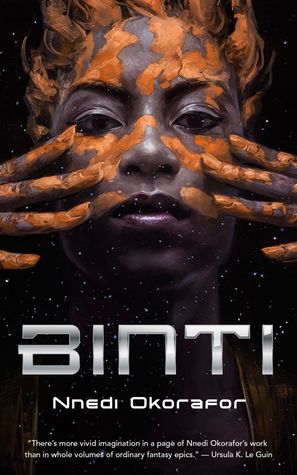
Binti

by

Nnedi Okorafor

My second book by this American – Nigerian author having previously read Lagoon.

I loved the way she takes two ostensibly diverse topics namely African culture and SciFi , and creates a fusion genre. Why shouldn’t a Himba woman become a student at the most prestigious university in this futuristic universe? Would the same prejudices follow her from Earth into the far reaches? Be echoed in the attitude of other beings?

Binti is the first Himba to attend Oomza Uni. Her family think it will change her. Other humans regard her (otjize) sweet smelling orange clay covered skin with disgust. They make her leave her bangles when boarding the space shuttle. From a family of harmonisers she uses her skill with mathematics and her particular cultural heritage to first survive a Meduse attack which wipes out the rest of the shuttle, then to mediate peace and create understanding where there had been none. Binti’s apparent differences in the end save her, humanity and their adversary, the Meduse.

ashramblings verdict 4* I hovered between 3 and 4 stars, finally settling on 4 because I am so intrigues by the premis for this short novella and by the promise it holds of hearing more from this exciting voice.

Saturday, 20 February 2016

The Sunset Limited by Cormac McCarthy

The Sunset Limited

by

Cormac McCarthy

Astounding. I listened to the excellent Audible version with Ezra Knight reading Black and Austin Pendleton reading White. It is like reading a stage play and made me go get the faithful to the book movie version which has Samuel L Jackson and Tommy Lee Jones teaming up with Jones directing with which it compares very favourably. What struck me about the writing was the way McCarthy's dialog beautifully creates a realistic intimate atmosphere between the two men who discuss the meaning of life after Black has stopped White from suicide on the station platform that morning. Their two perspectives are the result of differences in their race, their class, their educational background, their belief and non belief, their life experience as ex-con v professor, their attitude of eternal hope v despair and cynicism. Can Black save White? Can Black understand White's view? Can Black convince White? They hear each other out, but Black cannot stop White heading out to his date with death leaving Black still believing, till intending to be there for White on the station platform again tomorrow but asking his God "why didn't you give me the words?"  It leaves the reader wondering if they are two sides of the one persona, perhaps even America itself.

Footnote: I researched the train name and found that The Sunset Limited was a transcontinental train that crossed the American south from Atlantic to Pacific.

ashramblings verdict 4* astounding dialog, powerful performances. Highly recommended reading

Sunday, 24 January 2016

Sheltering from ties that bind

    A Sheltered WomanA Sheltered Woman
    by
    This short story is available online. 
    It won the Sunday Times Short Story Prize in 2015, at GBP30,000 it is the richest prize for short fiction, and the author is the first woman to have won it.

    It is the story of Auntie Mei who works as a one month nanny with newborns and their nursing mothers, leaving after each baby turns 1 month old. Auntie Mei is currently working for Chanel, a Chinese American wife, whose much older husband is away working, and staying away. The young woman is a reluctant mother, struggling to produce milk and love for her child, possible post natal depression, although perhaps just a post delivery recognition that her seduction and capture of the older man has backfired on her.
    The title is interesting - who is the sheltered woman? and what is she sheltered from? Is it Chanel, is it Mei, was it her mothers, her grandmother? Or all of them. Mei's own upbringing is a strange one, brought up by mother and grandmother, without male influence. The final line " When she moved on to the next place, she would leave no mystery or damage behind; no one in this world would be disturbed by having known her" suggests to me that it is Mei herself you is sheltering herself from her true self by the life she has chosen to lead - a childless woman perpetually working with newborns, only to leave them untouched and untouched by them when they are one month old. No wanting any ties that bind, she moves on quickly and apparently unregretfully to the next Baby. In many ways no different to the other characters inthe story, who all loosen, break ties to others.

    ashramblings verdict 4 * I do like stories which do not have a traditional ending!


    Love does not necessarily conquor all

    The Cove Audiobook


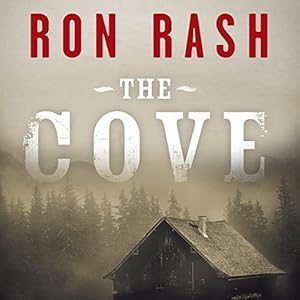
    The Cove

    by

    Ron Rash

    Narrated by Jennifer Woodward

    This story is basically a doomed war time love affair. Laurel Shelton and her war wounded brother Hank live in the cove, a dark forboding place in the Appalachian Mountains that their now dead parents had got cheap as no one else wanted it and which locals still dread. One day in the woods she finds a stranger, stung almost to death by yellow jackets and brings him home to their cabin. He cannot speak, but once recovered stays, helps around the farm and their love blossoms. But his past catches up with them all as Chauncey Feith, the local army recruiter, whips the town into a patriotic fervour, hunting down German sympathisers, getting German Professor Mayer bannished from the college campus, commandeering German books from the Library, setting up the boys brigades, and finally organising a big shindig as the local town prepares to welcome back its wounded local hero, gassed by the Hun.

    The story is well written, with good hooks along the way which are not explained but which lead the reader to the outcome of the story very well. The language is lovely, depicting time (towards the end of WW1) and place well (Appalachian Mountains in rural Carolina near the Tennessee border). There were lots of references to plants I'm not familiar with but which served to give the idea of a pre-war rural idyll with undeveloped, unspoilt countryside. Rash also portrays the hard life of the agricultural inhabitants in such a backwater, ignorant and bigoted, where the lynch mob rules whether targetted at those with a birthmark who are deemed to be a witch (Laurel Shelton), or of those of German ancestry who are deemed to be spies. Sadly one could make parallels with views held in some quarters about muslims today, and as we are shown in the Prologue to the story, the insular nature of such locations lasts on.

    I'm really not a fan of American women readers – usually their voices are too brash, too high pitched for my ears, but this one was OK.

    ashramblings verdict 4* My first book by Ron Rash and mightily impressed by him as a story teller

    Thursday, 21 January 2016

    Gok Wan restyles Anne Reid!

    The Matisse Stories

    by

    A.S. Byatt

    I’ve only read one AS Byatt before The Children’s Book which I had struggled with. This led to my book club buddy recommending this collection and the Djinn in the Nightinggale’s Eye as the best ones to try and I have only now got round to reading more Byatt because my online book club’s short story thread is reading the first story from this collection over the next fortnight.

    The collection begins with the story “Medusa’s Ankles” which can also be found online. Middle aged and plump like the Matisse Pink Nude which had originally drew her to this hairdresser’s salon a year or so ago, Susannah is sat in the chair struggling with the continuous inane commentary from the hairdresser about his mixed up love life, his revamp of the design of his salon to jarring techno-black, her own increasing flabbiness and concern with her aging body and dying hair. Her cathartic explosion in the story is dramatic and its ending brings home just how much our own view of our bodies differs from the view of others.

    I struggled with reading this story, finding many of Byatt’s sentances jarring and hard work to read. Perhaps this was the author’s intention – to get this reader into the same frustrated state of mind as Susannah – if so it worked and the story in the end made an impact on me such that it encouraged me to hunt out and listen to an audio version of the whole collection (The Matisse Stories unabridged audiobook by Recorded Books read by Virginia Leishman (1997) is available on Scribd). After listening to the story read, I realised this would make an excellent screen play/short film, with a sort of Gok Wan like actor playing Lucien and Anne Reid playing Susannah.

    The second story “Art Work”  tells the story of the family life at 28 Alma Road where Debbie a rushed of her feet mother handles her work-at-home artist husband, Robin, her own “breadwinner” work as design editor at a magazine, their children and their housekeeper Mrs Brown. Debbie believes Mrs Brown has become indispensible, making cushions, jumpers in bright colours and goading and baiting “him” by moving thinks around that Robin is sketching causing Debbie to act as peacemaker between her cleaner and her husband. This relationship between Robin and Mrs Brown, comes to a climax over a disagreement on colour.

    Then gallery owner Shona McRury comes to see Robin's paintings  which she considers to be about the littleness of life, whereas he thinks they are about the infinite nature of color. Robin sees them as non repetitive series about colour and space, whereas McRury  sees then as increasingly repetive and increasingly boring. Unable to articulate what he is trying to achieve, McRury leaves Robin without the hope of a show. Mrs Brown follows her out of the house and Debbie sees the two engage in conversation but hears nothing, She is left in as much of the dark about the conversation as the reader is until the next scene when Debbie’s magazine is invited to McRury’s gallery.

    I suppose the story if about transformation of Mrs Brown and of Robin, but Debbie remains as before the stalwart,m ainstay of the family, holding it all together with the help of a replacement cleaner and Robin and Mrs Bown adjust themselves to the experience. 

    The third story is entitled “The Chinese Lobster” and can also be found online. Its a story about academic politics and how it handles an accusation of sexual assualt on a student who openly wants a different tutor, one more sympathetic to her viewpoint. Sadly ths story, once again left my totally bemused by Byatt.

    Byatt stories for me always seem to evoke an elitist, middle class, London intelligensia, not only in her characters but also in her words, symbolism and references, in this case to various artworks. I suspect this makes her works rather inaccessible to some readers. I remain to be convinced by her writing which always makes me feel I am missing something from her work but which also makes me keep trying.

    ashramblings verdict 2*   I continue to struggle with Byatt.

    Friday, 1 January 2016

    A runaway success!

    The Year of the Runaways

    by

    Sunjeev Sahota

    This is the story of the lives of migrants, legal and illegal. Randeep, Avtar and Tochi live in a house in Sheffield. It shows the reasons why they made the trip to the UK – lack of money, lack of work, poor harvests, the precariousness of life in the face of mounting debt, parents and siblings to support back home (Avtar) , or after their violent caste provoked deaths (Tochi). The routes taken – selling kidneys, taking out loans to pay for student visas, loans to secure the family’s business in times of economic stress, the arranged marriage-visa route and the “back of a lorry” route. Randeep’s visa wife is Narindar a highly religious British Sikh, who has chosen this route, against family honour and community values, to help where once she could not, to now do what she considers “the right thing”. This is their story over the course of a year when their 4 lives are flung together. They struggle to find work with their “fauji” status, even with student visa, a marriage visa, there is a fine line of difference between them and Tochi’s fully illegal status. They  have to keep their money as cash, sending most of it back home, as regular, and as much as possible, balancing the need for this, with the demands of the loan sharks UK agents, with eating, surviving on roti and sabzi fo rthe most part. They are easy prey to the unscrupulous gang masters, shop and restaurant owners who pay them a pittance for long hours of work in terrible conditions, never mind those who steal their passports and lock them up at night between workdays. Its a grim but realistic account of a life most of us are comfortably ignorant of. Sahota captures very well the characters, their plight, their hopes and fears, their brotherly love, their isolation, their moments of tenderness and humanity, of brutality and survival.

    ashramblings verdict 4* and a very just 2015 Booker shortlisting. The audio version is read brilliantly read by Sartaj Garewal giving the Hindi vernacular an authentic ring, thereby helping readers not used to the sounds, intonations, or vocabularly, the integratiion of which, in my opinion, Sahota handles really well removing the need for a glossary.

    Friday, 18 December 2015

    Sci-fi shorts still work

    The Illustrated ManThe Illustrated Man

    by

    Ray Bradbury

    Some time back my onlne book group read Bradbury’s short story “There will come soft rains”. We found the following excellent reading by Leonard Nimoy.


    This inspired me to want to read more of this classic sci-fi writer’s work, so I picked up The Illustrated Man, and was not disappointed. Even for non lovers of sci-fi I think there is something here. Written in the late 1940s/early 1950s its amazing how relevant some of his social commentaries are today. For example in “The Other Foot” we are on Mars, inhabited only by black people, the whites having stayed on Earth. But after years of separate existences, Earth has disintegrated and suddenly the Martians are faced with an earth ship landing. The community faces up to how it should treat these whites wanting sanctuary on their planet – shoudl they treat then with all the hatred and discrimination they had shown to black folks on earth? or should they treat them like fellow human beings? Remember he wrote this in a time when linchings were still happening, the KKK was very active, and the racial divide absolute.

    Other stories which resonanted well with me were “The Long Rain” the story of the spaceshipwrecked crew on the eternally wet Venus as they try to reach the dry, warm, quiet of the Sun Dome; “The Vedlt” with its concept of the children’s playroom which made their thoughts and play like reality, a some of interactive holographic play suite, I suppose; “The Fox in the Forest” where a couple have escpaed the horror and war of 22nd century with its leprosy bombs, radioactive madness for the sunshine, smells, sounds, tastes of 1938’s Mexico,. But have they escaped the Searchers who like bounty hunters hunt down Travel in Time, Inc.’s holidaymakers who “forget” to come home. What I liked was his ingenious devices and scenarios, which for me still work some 60-70 years after he wrote them. 

    I listened to the audio version read well by Scott Brick, my only issue with the audio was that Tantor Audio could have made a little longer time spacing between the individual stories

    ashramblings verdict 4* Great selection of sci-fi stories which still work today

    Monday, 14 September 2015

    Contrasting coping mechanisms revealed

    The Illuminations

    by Andrew O'Hagan

    Yet another book about dementia and memory!  This time threaded through with the story of dementia sufferer’s grandson, Luke, who is a soldier. Anne, the grandmother, is getting less able to survive in the sheltered accommodation that is currently her home, even with the help of family and neighbours. Luke has returned from serving in Afghanistan, still dealing with the death of his colleague, the inadequacies of their commanding officer and their betrayal by a fellow Afghani officer.

    The book alternates  between Annie’s story and Luke’s both in Afghanistan and once he is back home in Scotland. Always closer to his gran than his mother, Alice,  ever has been, he sets about helping her to get ready for the move and discovers much more than they ever knew about Anne’s past. SPOILER ALERT – That past is her origins in Canada, that she came to look after aunts in Scotland, became a famous documentary photographer in the 60s, fell in love with a married man with whom she spent time in a a flat in Blackpool (hence The Illuminations)  and who left her high and dry, pregnant with Luke’s mother and an unknown twin brother, who died as a child, and surrounded by lies.

    I like the characterisations throughout – of Anne, of her neighbour, and of Luke and the boys from his platoon. I did struggle with the dialog of the army life, but therein lies the contrasts at the heart of this novel – coping with the battlefield now and after the soldiers try to loose their memories of war in drug fuelled nights on the town, in playing computer games, whereas the Memory Club tries to help the old folk cope with the passing of time, to recall their past youth, the past familiar, to enable them to continue to live semi-independently in the now. As Luke decides not to return to the army life, his exploration of Anne’s past is “illuminating” of her, of his mother’s relationship with her, his own and himself, of different ways of dealing with memories, loss, lies and cover ups.

    ashramblings 3* I suspect some people will really like this novel, but for me it was just a bit to sentimental. Not my normal read, but it would make a fine, topical, dramatization for TV.

    if I were fishing for a winner…..

    The Fishermen

    by Chigozie Obioma

    A 1990s middle class Nigerian childhood in which the loving Agwu family is torn apart by the prophecy of the “madman” Abulu. Freedom for the four eldest boys comes when their father’s work at the bank means he has to live in Yola in the north far away from their southern home in Akure, returning only at the weekends, and they go fishing in the local river, the Omi-Ala, which has, unbeknown to them a bad reputation, having once been worshiped by local people.  It is there that Abulu’s prophecy of fratricide is uttered.

    The character and story of Abulu is marvellous in itself – how he became the man he is today, what he did (raped his mother), how he looks and what he does (public masturbation) and says (prophesies) -  as is the whole mix of African storytelling and Western novel. The  first disintegration is of Ikena, the eldest son who is knocked of balance by the prophecy which shatters his love for his brothers. He begins to seriously fight with Boja, the next in age with whom he shares a room, and so the downward spiral of destruction starts despite his brothers pleas that they love him and would never harm him. The reader really buys into the conflict as retold by the now adult Benjamin recalling his childhood experiences and memories – his child’s voice is very authentic.

    Nigerian politics is a backdrop to a number of aspects of the story. The period is that of the military dictatorship of General Sani Abacha between the 3rd and 4th Republics, when the father wants his sons to be successful and has planned out various careers – doctors, lawyers etc   - and to put behind them the corruption of the country through education and ambition. The change in status of the river echoes the change in perspective of the regime. The boys meet opposition candidate MKO Abiola and the fate of the gifted calendar is part of the story of destruction.

    Likewise the prophesy does not just impact the killer and the killed brother, but affects the others in the family. The mother, unable anyway to cope with the boys unruly behaviour whilst nursing their baby sister, has a nervous breakdown when Ikena is killed. The father has to give up his job and return home as he sees not only his career, his ability to provide for his family, but also his dreams for the boys’ future destroyed in turn. His resolve and love for his wife and children really come through in his determination to manage no matter what – he opens a bookshop to earn money, he hides his wife’s illness so no one will taint her, he tries to cover up his inadequate attempt to deal with Abulu so she will not know and never worry over this as well.

    SPOLIER ALERT – the family is in effect hit by multiple tragedies – Ikena’s murder, Bola’s suicide, mother’s breakdown, father’s loss of professional status. father’s inability to see to Abula, and then Obeme and Benjamin’s murder of Abulu and a soldier who interrupts them.  Whilst Obeme runs, it is Benjamin who stands trial, his father encouraging him to stand talla nd tell the truth about why they did it. Condemned to imprisonment till he is 18 years without family visits, he is eventually released when there is a change in government, he is welcomed back home at the end of the book when Obeme also return on the same day “to face their father together”

    I loved this story, the writing style, the characters, the the author has Benjamin describe each of the main people of the book in their animal form – tadpoles, falconer etc. As such it really does blend African and Western traditions seamlessly and smoothly. My radar is on high alert for his next book. This one has, quite rightly in my opinion been longlisted for the 2015 Booker, for the Guardian First Book Award and other prizes.

    ashramblings verdict 4* and I might even be persuaded to give it more! For me, so far, this is the best of the 2015 Booker Longlist I have read.

    Monday, 31 August 2015

    If the dead could tell the real story

    Echoes from the Dead (The Öland Quartet #1)

    by

    Johan Theorin

    The death of a child must remain with its parents for ever. How much worse when there has been no body found. The story of Jens, a five-year-old boy who went missing 20 years ago, but whose body has never been found, is told alongside that of Nils Kant, a wayward boy from the island who lies buried in the local cemetery. Jens' mother, Julia,  and grandfather, Gerlof, unearth the true story of what happened that day. Their search brings Julia back to life from her paralysed state of denial. This is a really great thriller, so no surprises then that it won Best First Mystery Novel by the Swedish Academy of Crime in 2007. It has an excellent plot that holds the reader all the way through. Moreover the author gives excellent descriptions of the local terrain, the Swedish island of Öland and bleak remoteness of the alvar. I could see Max von Sydow  playing old Gerlof in a film version quite easily as Theorin's characters are well described, but upon checking it was Tord Peterson who played him in the 2013 Swedish film. Definitely good to see more of these great Swedish thrillers available in English, hopefully more as movies soon as well

    ashramblings verdict 4* Excellent thriller

    Saturday, 29 August 2015

    Bringing back memories of India but with a hint of darkness

    Sleeping on Jupiter

    by

    Anuradha Roy

    As a seven year old Nomi sees her father murdered by armed men, looses her brother, and is finally abandoned by her mother before being picked up and transported to an orphanage run by a great spiritual guru who heads an ashram. Instead of love, she finds abuse and finally aged 12 she escapes the sexual gratification of the Guruji only at the cost of leaving behind her only friend. She ends up in an orphanage and is adopted by an Norwegian woman.  At 25, a now slightly punkish, English speaking westernised woman with a splattering of broken, long unused Hindi returns to the fictional town of Jarmuli on the eastern seaboard of India ostensibly to make a film but with a wish to tie up the loose ends of her life story, to keep promises made to her friend Piku, to finally tell the truth.

    Old ladies on the beach_croppedOld ladies on the beach_cropped2

    Roy intertwines Nomi’s return with the very contrasting lives of three elderly, very conventional, Indian women, Gouri, Latika and Vidya, who have come on their first ever holiday together. The town’s beach and  temple provide a living for the locals and a focal point for much of the action of the story. There we encounter the women’s tour guide Badal trying to woo street boy Raghu, the subject of his unrequited homosexual love. Raghu makes out as best he can, cadging from others, working at the beach tea stall of Johnny Toppo etc. Johnny Toppo continually sings and hums sad songs and may well have been the young gardener of the ashram back in the day. And finally there is Suraj, Nomi’s assistant, I suppose a bit like a local fixer, but who is trying to work out the breakdown of his own marriage.

    Each of them is escaping something, each has their own dreams, in Badal’s case of “living on Jupiter and sleeping under its many moons” where there just might be a full moon every night, to bring light into the darkness and keep you safe. Because rumbling constantly just below the surface of one’s life is danger, despair, and violence. Perhaps it is the somewhat minor character of Raghu who shows best that this precariousness still exists in today’s India, bonded labour, living from hand to mouth on the streets, at the whim of the tea stall holder. Badal has his escape fund hidden in a bank account his uncle doesn't know he has, he has his scooter.

    Kornak temple detail 2Kornak temple detailKornak Temple.


    Reading this reminded me of visiting the beach resorts on this part of the Indian coastline, the temple at Kornak with its salacious, almost pornographic stone carvings on the Kama Sutra and the double standards of Indian views on sexuality and the place of women.

    Overall the book touches on an important subject matter thread, but I got to the end of it wishing it had been more. More what? I am not sure. More explicit, more violent? Perhaps I am now too used to reading Scandinoir! On the other hand, one could argue the softening of the violence is appropriate as it is how it was all being related, years after the event, by Nomi and that her blurred memories, jotted down from 12 to 25 into her manuscript are a collage of fleeting moments, muddled by emotions of the moment, of regret, and of survival.

    ashramblings verdict 3* Evocative read.

    Saturday, 8 August 2015

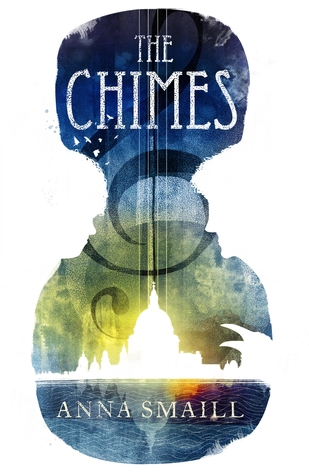
    An orchestral composition - The Chimes by Anna Smaill

    The Chimes

    by

    Anna Smaill


    Many of the write ups about this book cite it as challenging, unusual, difficult to get into and as requiring perseverance to work into the storyline. Yes, those statements might be true and Winner it will not be but surely this has to be shortlisted for this year’s Booker Prize. It is on the Longlist and deservedly so, because it is a remarkable piece of writing.

    In telling the story of a post apocalyptic world (London and Oxford) where memories have been destroyed, writing is long forbidden, in which communication is via music with all its chords, harmonies, rhythms, modulations, cadences and key changes are used to signify distance, direction, shape etc.

    Simon has come to London where the population’s communal memory loss is enforced by means of the Carillon, an immense musical instrument which brainwashes everyone with its musical message beginning with “Matins” which tells the “OneStory” of the “AllBreaking”, the “dischord” that destroyed the past and created the present now, and ending the day with “Chimes” at “Vespers” when mental faculties are bombarded leaving the people with only their “bodymemory” to get them through sleep, and to wake again the next morning in a endless repetition and dying in a state of “chimesickness”. Simon carries with him a bag full of precious “objectmemories” which enable him to recall and fell calm about some moments in his life. Loss of these would mean total “memoryloss” and destitution.

    Simon falls in with a group of young “pactrunners” (Lucien, Clare, Able and Brennan) who scour the leftovers of London’s underground networks of tunnels  for nuggets of Palladium which they sell. The Palladium is used by “The Order” to build the Carillon. In this first half of the book the author needs to deftly find a way to tell us the story when the world is supposed to not use words and writing. How she does this is what makes the first part difficult for many readers – words are misspelt eg trompet, prentissed, poliss, others words are used just ever so slightly out of context and unexpectedly but continuously eg subito, presto, lento, and place names and slightly altered eg The Isle of Dogs becomes Dog Isle. All this gives you a sense of how over time what had been the English language had changed once writing disappeared and only sound communication survived on the street.

    SPOILER ALERT But as with all dystopian states the disorder and chaos of the masses is controlled and the elite exist in a different place, in this case Oxford where the Order overseas the production of music and the “Orkestrum” of the Carillon’s calls. Also not surprisingly their has been a underbelly of resistance, “The Ravesguild” a network of “memorykeepers” to whom people brought memories for storing before they were completely lost. The Ravesguild is all but annihilated, and only the last memorykeeper, Mary, survives behind her mad-woman facade.  It falls to Simon and Lucien to bring all the memories together in a new music piece which tells the true story behind the Allbreaking and to somehow play it through the Carillon to open up and birth a new dawn and free the people from their enforced collective amnesia.

    Yes there are obvious similarities here to Philip Pullman’s His Dark Materials Trilogy, but for me that doesn’t distract from the work. The storyline held me all the way through. Whilst reading it I kept thinking that the real challenge for this book is to fund a film director and a musical score writer who would take up the challenge of composing the score in such a way that the different characters, the “bodymemories”, the mapping of the tunnels, tube lines, sewerage systems of London could all be made music. At one point in the book, Simon is being given the last memories held by Mary and each one of them tells a part of the story of what it is like to really be human – each with their own melody. I’m not knowledgeable enough about musical composition but I’d just love to see this done, with phrases to identify each of the characters, using rhythm for direction, key change for shape, modulations for direction etc. and then bringing them altogether in the final Carillon piece for full orchestra. The idea has tremendous potential. Potential also for a backstory/prequel about how The Order rose to power, how The Chimes first started, how the sickness spread, how the Ravensguild was inaugurated, founded and eventually fell.

    I don’t expect this to be Longlisted, but I do hope t gets shortlisted to encourage a wider readership.

    ashramblings verdict 4* An orchestral composition on the theme of memory, freedom, identity and the essence of humanity, love.