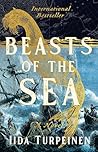
 Beasts of the Sea
by
Iida Turpeinen
My rating:
4 of 5 stars
My in person book group read
Andrea Wulf's
The Invention of Nature: Alexander von Humboldt's New World a few years back and I was a bit surprised by how much people did not know - bear in mind we live in a town known for its connection with
Sir Joseph Dalton Hooker a botanist and explorer and one time director of the Royal Botanical Gardens, Kew London.
This book is of a similar vein in that it takes real historical events in science and weaves a story covering episodes in the years 1741, 1859 and 1952. The common thread is to do with the
1741 Great Northern Expedition by Captain Bering ( yes, he of the Straits) where the naturalist
Georg Wilhelm Steller describes the
Hydrodamalis gigas or the sea cow which now bears his name and whose skeleton resides today in the Finnish Museum of Natural History.
The other years cover stories of other 'lost' scientists and their connection to this enormous, almost mythical creatures. Constance Furuhjelm, sister to the Governor Furuhjelm of the Russian American Company which was involved in establishing communities in what was then called Russian America ( i.e Alaska prior tot he US purchase of it from Russia in 1867). Constance was a real person, but as a disabled person her story is 'lost' but Turpienen takes it up amongst the state's taxidermy collection.
Next she shapes a story of Hilda Olson, often reckoned to have been the
first female scientific Illustrator who drew the skeleton of the sea cow and is famed for her drawings of spiders!
And finally the story of
John Grönvall an environmentalist and ornithologist, and master egg restorer ( those were the days of collecting eggs) and this renowned collection still exists in the Museum Oologicum R. Kreuger collection at the Finnish Museum of Natural History. His contribution to this trilogy of episodes is that he dismantled and restored and reassembled the skeleton of the sea cow for the University of Helsinki Museum in 1952.
It is a very readable book, I think for scientists and non-scientists alike. Where Turpienen succeeds is to create vibrancy and give life to these historical figures. To tell their stories, to link into issues such as the lack of recognition given to woman scientists, and to the then novel idea that species could go extinct not just in geological time but within living memory, something we see today at an alarmingly increasing rate. Reviews, like that in
The Guardian where I first came across the release of the English translation, criticizes its lack of depth to its coverage , especially in the mid section on Furuhjelm's . But I thoroughly enjoyed it, thought it was well written as it fair pulled me along. She is definitely an author to look out for.
 Perfection by Vincenzo Latronico
