Showing posts with label Japanese Literature. Show all posts

Saturday, 17 June 2023

Book Review: The Ten Loves of Mr. Nishino by Hiromi Kawakami , translated by Allison Markin Powell

The Ten Loves of Mr. Nishino The Ten Loves of Mr. Nishino by Hiromi Kawakami
My rating: 3 of 5 stars

For me this novel was not as good as Strange Weather in Tokyo but I still enjoyed the read. Like Strange Weather it address the difficulties of modern relationships. 10 women give their story of their relationship with Nishino at different stages of his life. These are not rendered chronologically . We never really hear him, his voice and in many ways we and many /all? of the women never really knew him , nor understood him. They all break away from him even though he would appear to be a 'catch'. They say he doesn't want commitment, but perhaps it is the women who are commitment phobes?, some are only after sex, some are not really interested in Nishino the person, but he does leave his mark on them all.
I like Kawakami's writing style, sparse, simple, deep, thought provoking. Her stories stay with me.
Another of her short story collections is appearing in translation later this year Dragon Palace

View all my reviews

Thursday, 10 November 2022

Short Story Podcast Review: The Cafeteria in the Evening and a Pool in the Rain by Yoko Ogawa, read by Madelaine Thien

The Cafeteria in the Evening and a Pool in the Rain The Cafeteria in the Evening and a Pool in the Rain by Yōko Ogawa 

Text at https://www.newyorker.com/magazine/20...
Audio at New Yorker Fiction podcast Oct 1st 2022
I just listened to Yōko Ogawa's story The Cafeteria in the Evening and a Pool in the Rain on the New Yorker Fiction Podcast Oct 1st 2022 . The podcast audio is read by Madelaine Thien. For me here voice took a little getting used to, I found it too soft, airy, and had to grind my teeth a bit, but I persevered and acclimatized enough to enjoy the story. What was excellent was the discussion Thien and the podcast host Deborah Treisman had about the story afterwards. One to recommend I think.

View all my reviews

Sunday, 31 July 2022

Short Story Review: A Slow Boat to China by Haruki Murakami

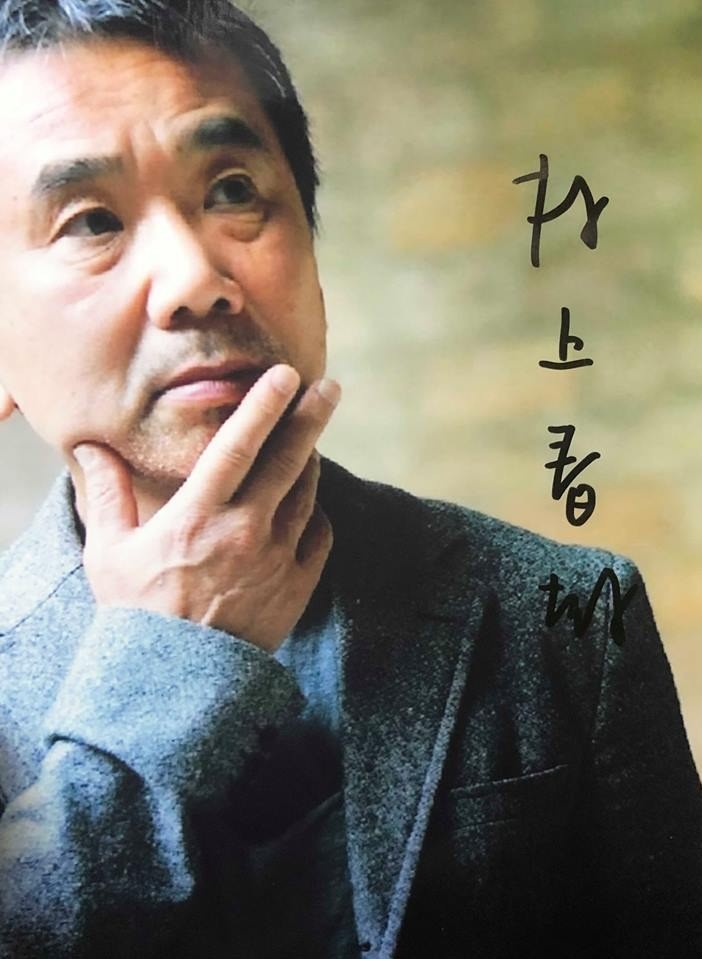
Haruki Murakami (signature), CC BY-SA 4.0, via Wikimedia Commons

A Slow Boat to China by Haruki Murakami
My rating: 4 of 5 stars

Murakami's first short story can be found in the collection The Elephant Vanishes by Haruki Murakami and if you have access to Jstor at https://www.jstor.org/stable/4384180

The introspective narrator tells the reader the stories of his first encounters with Chinese - the teacher in the Chinese elementary school at the edge of the world", mistakes made on a first date with a Chinese co-worker, an encounter with a encyclopedia salesman.

Written with some beautiful phrasing eg "The years '59 and '60 stand there like gawky twins in matching nerd suits." and "...the new me - five chickens and a smoke away from what I was...."

View all my reviews

Tuesday, 25 January 2022

Short Story Review: The Walker by Izumi Suzuki, transl. by Daniel Joseph

The Walker

The Walker by Izumi Suzuki
My rating: 3 of 5 stars

Test available online at https://granta.com/the-walker/

Izumi Suzuki was Japanese writer living between 1949 and 1986. The most informative account of her I found is from 2021 posting on Literary Hub (https://lithub.com/a-writer-from-the-...) from around the time her story collection Terminal Boredom: Stories appeared in English with stories translated by Polly Barton ( whose name I recognised from several other translation of modern Japanese writers), Sam Bett, David Boyd (who has written about translating her work https://hopscotchtranslation.com/2021... ), Aiko Masubuchi, Helen O’Horan and Daniel Joseph who is the translator of this story. That collection is all the has been translated thus far.

According to Granta, Daniel Joseph holds a Master's from Harvard in medieval Japanese Literature and who according to his Amazon's page he specializes in both modern and classical literature, science fiction, pop culture, music, and the avant-garde, and if this story is anything to go by that list may qualify for the addition of the term 'weird' ,

The Walker is a short 4 page story, set in some unknown time and place where a narrator seems to have been walking for ages and seems icompelled to continue to walk, except that she encounters a woman with food cart. ******SPOILER ALERT*** hungry and with no money she exchanges an item of jewellery for food. This seems a fantasy encounter, told quite realistically, but the final twist left so gobsmacked, my only though was 'How strangely weird!'

I've put Terminal Boredom: Stories on my To Be Read List 


Postscript: Daniel Joseph has also written about her on Art Review  in 2021 (https://artreview.com/how-izumi-suzuki-broke-science-fiction-boys-club )

Wednesday, 17 November 2021

Short Story ChapBook Review: Friendship For Grown-Ups by Nao-Cola Yamazaki, translated by Polly Barton

Friendship For Grown-Ups Friendship For Grown-Ups by Nao-Cola Yamazaki
My rating: 3 of 5 stars

This is my first read from this series of chapbooks beautifull produced by a collaboration between University of East Anglia (famous for its writing MA) , Writers' Centre Norwich, and Norwich University of the Arts - see https://www.strangers.press/keshiki

Nao-Cola Yamazaki was not a familiar writer to me, her 3 stories in this chapbook are all translated by Polly Barton, see https://www.pollybarton.net , who is the translator of a few Japanese women writers that are on my to be read list.

The 3 three linked stories total 45 pages and are bound in an 'arty' cover somewhat reminiscent of the 70s and are introduced with a Foreward written by surreal short story writer Aimee Bender.

The first story, entitled "A Genealogy", is a downright 'weird' meditation on evolution and the genealogical lineage to the character of Kandagawa.

In the second story, entitled "The Untouchable apartment" we again meet Kandagawa whose somewhat dream like state is interrupted by a phone call from her previous boyfriend, Mano. They end up going to see their old apartment which now no longer exists, just like their relationship. They spend the day together but Kandagawa realises she is no longer the girl she was when they were together four years ago - not quite Jesse and Celine or Before Sunrise / Before Midnight.

"Lose your Private Life" , the third story is about a young women Terumi Yano, writing under a pseudonym of Waterumi Yano, as she struggles to come with what this means for her identity as she becomes more well known as a writer, how new people she meets will only know Waterumi and never again know the Teruni that her university friends Mano and Kandagawa know.

These weren't stories that 'blew me away' but at points did intrigue me. I thought about whether there was an autobiographical element to the final one or whether this was a clever slight of words illusion on the part of the author for example when she had Waterumi's book be entitled "Friendship for Grown-ups"

Thursday, 28 October 2021

Review: Convenience Store Woman

Convenience Store Woman Convenience Store Woman by Sayaka Murata
My rating: 4 of 5 stars


Keiko Furukura is a not so young, unmarried, somewhere on the spectrum, virginal, convenience store woman that is she works in a small neighbourhood store Hiiromchi Station Smile Mart. Being in Japan her routine is full of morning practice when staff recite en mass greetings, “Irasshaimasé!" and other soundbites, being Keiko she reckons that watching and mimicking the store manager's video of the model store worker taught her "how to accomplish a normal facial expresiion and manner of speech", so for 35 years she has donned the same unniform and transformed into "the homogenous being known as a convenience store worker" and become a "normal cog in society". Except that she is not, she remains in the same job, remains unmarried, remains withut ever having a relationship until a new member of staff arrives, Shiraha. But this is not a girl meets boy, falls in love, and live happy ever after story. It is a story about being oneself, not what others expect you to be.

Sayaka Murata's story won the 2016 biannual Akutagawa Award (https://en.wikipedia.org/wiki/Akutaga... ) which is awarded to "the best serious literary story published in a newspaper or magazine by a new or rising author". It, and other Murata books, have been translated by Ginny Tapley Takemori (https://www.wordswithoutborders.org/c... ) and the Audible version is wonderfully read by Nancy Wu (https://www.audiofilemagazine.com/nar... ).

4* For someone who does not usually like higher pitched voices, Wu's Keiko kept me glued to the audio. For someone who doesn't normally like novels about thirty-somethings' angst, Murata's novel sped along and was a delightful read. At only 163 pages it is well worth popping in your bag for a train/plane journey.

Thursday, 15 April 2021

Book Review: The Inugami Curse (sometimes called the The Inugami Clan) by Seishi Yokomizo

I don't often read Detective Fiction, although I love a good Noir detective movie. I read this when I signed up to a coourse in Japanese Crime Fiction at City Lit in London. I have read a couple of the Pushkin Press Vertigo Imprint Crime series and enjoyed them before and had been meaning to combin my love of Japanese novels with this. So this was my first foray. 

I found it a quite dry, very analytical novel. The character of the detective is not well developed but then it is only the second in this series, but it is very clear to follow even thught it is a convoluted plot with multiple murders, and imposter characters, and the characters are linked by historical family events - the story set in post war Japan essentially begins by reading the complex will of the deceased Head of the successfull Inugami family. I suppose this is quite a traditional murder mystery in that the 'star' detective wrestle with people's manners, words and deeds, until the end when everyone left standing gathers for the reveal of the murderer. 

An quick and easy read, the main facts and times of the story line being summarised at various points and the detective has a sidekick of the policeman to play off as his internal thoughts are relaid to the reader partially through the interactions between these two people.


View all my reviews

Thursday, 20 August 2020

Book Review: Sweet Bean Paste by Durian Sukegawa

Sweet Bean Paste Sweet Bean Paste by Durian Sukegawa
My rating: 3 of 5 stars

Slow and gentle story of friendship. It is subtle, full of brush strokes worthy of a grandmaster of the floating world - simple yet complex, seemingly light yet heavy with meaning. Just after finishing this story I watched the first episode of a BBC series entitled The Art of Japanese Life and was struck with so many similarities between the style of many modern Japanese novels and what the documentary was saying about the role of Nature , Zen and Shinto in Japan. I also watched the movie of this book directed by Naomi Kawase in intimate close up, perfect for the sentiment of the novel.

View all my reviews

Sunday, 21 June 2020

Book Review: The Housekeeper and the Professor by Yoko Ogawa

The Housekeeper and the Professor The Housekeeper and the Professor by Yōko Ogawa
My rating: 3 of 5 stars

The Japanese do love stories like calligraphy, delicate brush strokes full of meaning, subtle yet straightforward, simple yet complex.

In this novella, a single mother is sent by an Agency to housekeep for a "difficult" client, a Maths Professor who lives in a cottage in the garden of a larger home occupied by his sister in law, a widow. After a car accident he has only 80 minutes of memory cycle for events post that time. To aid him getting through the day he wears the same suit, studded with notes to help him remember things, like that she is his housekeeper and she has a young son, whom he has nicknamed Root. The three of them develop an unexpected friendship through a love of numbers, mathematics and baseball. Now I'm neither knowledgeable about mathematics or baseball, and that might bog some readers down but for me it didn't matter mucvh because what matters is that the writer conveys the Professor's passion about numbers and about his baseball idol Enatsu as a way of showing the man the Professor was but also still is, a passionate person who cares deeply about children and sees beauty in numbers and the evening sky.

The book is narrated by the unamed housekeep, looking back on her years with the Professor. How reliable a narrator is she? Well the book is her memories, one sided perhaps, but clearly full of tender affection for the man, and for the love, inspiration, attention and praise he showed her son, who ended up being a teacher. She of course does not know and so neither can we as readers what exactly the relationship between the Professor and his sister in law was leading up to the car crash, but we can hypothesis. From a practical point of view the idea of notes pinned to the Professor's suit is a bit unfit for the purpose of remembering, but serves another purpose - it makes him appear ridiculous at first sight, like a jester or fool which he is most clearly not, and as such serves to reflect how society often views and treats people with memory loss, dementia etc .

View all my reviews

Wednesday, 9 October 2019

Movie Review – Woman in the Dunes (1964) Dir. by Hiroshi Teshigahara, from the book by Kôbô Abe

Woman in the Dunes
Director: Hiroshi Teshigahara
Writers: Kôbô Abe (novel and screenplay)
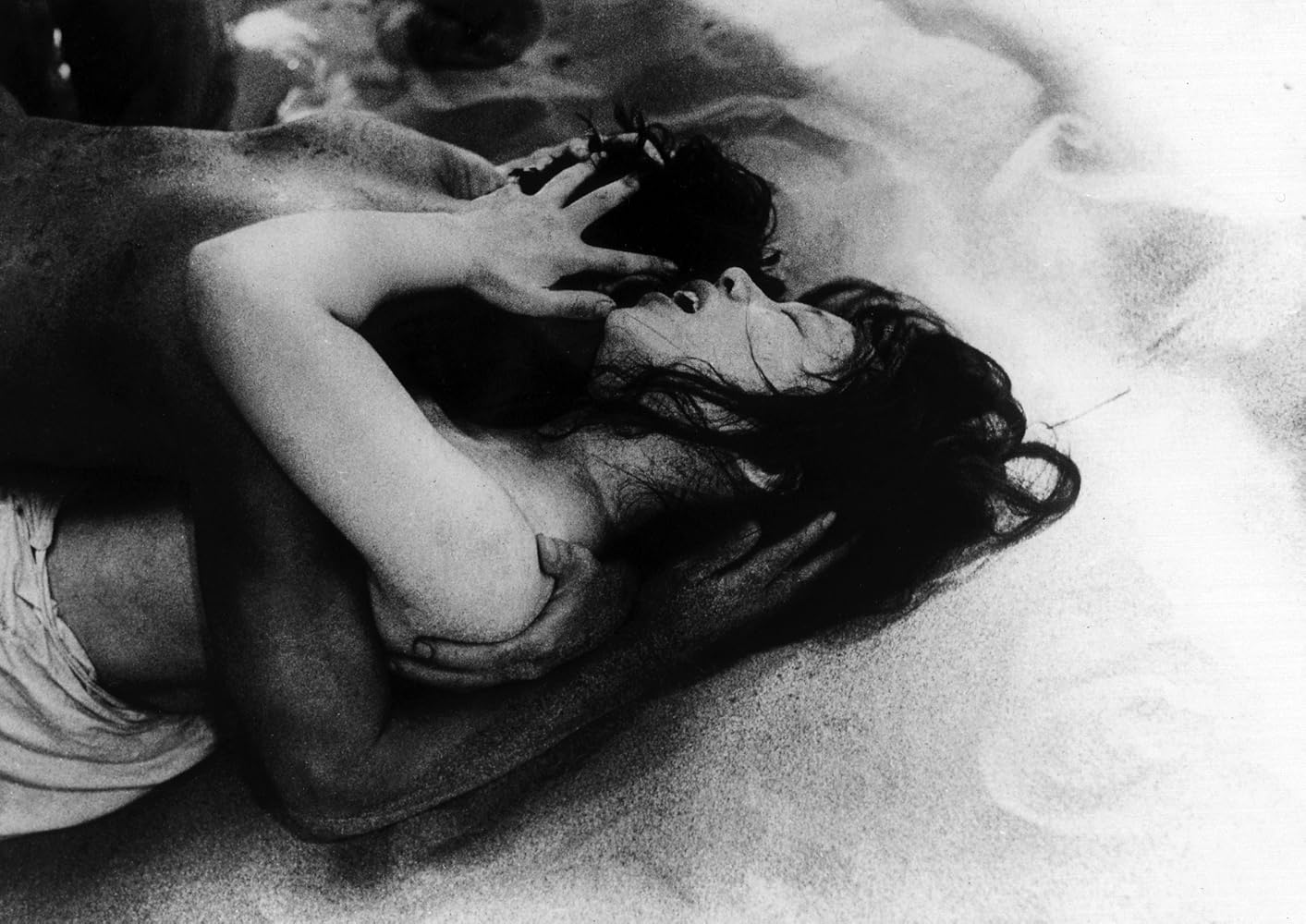
Tonight our local Arts Centre The Cut had its weekly cinema night. The movie was the Oscar Best Picture 1966 nominated Woman in the Dunes directed by Hiroshi Teshigahara with screenplay written by the author of the novel of the same title,  Kôbô Abe. I read the book several years ago see my blog post. At the time the book had quite an impact on me I borrowed it from our local library  @HalesworthLib – I gave it 4* , so when I saw the movie was to be shown I had to go. I was not disappointed. A fantastic arts cinema movie full of exacting cinematography, stunning close ups of sand grains, dunes, skin, facial pores, bodies, hands. Filmed in black and white, the movie is full of light and shade, shifting landscapes, contours, curves both of the sand dunes and people. The score is trident, sharp and cutting, never letting you as the audience settle. Very apt.  For a great review of the movie you can't beat Roger Ebert’s which I think is spot on. Not a full house but well done for whoever choses the movie selection at The Cut for this brave and beautiful choice. A great cinematographic experience.

@newcut.halesworth @CutHalesworth

Wednesday, 16 January 2019

Review: Thousand Cranes by Yasunari Kawabata, translated by Edward G Seidensticker

Thousand Cranes Thousand Cranes by Yasunari Kawabata
Translated by Edward G Seidensticker
My rating: 3 of 5 stars

Kikuji is invited to a tea ceremony in honour of his dead father. The ceremony is conducted by his father's mistress Chikako Kurimoto who has taken it upon herself to as as go-between to organise a meeting for him to "view" a prospective bride Yukiko Inamura. However at the gathering is also Fumiko Ota and her mother who had been his father's long time lover at the time of his death. Kikuji begins a relationship with Mrs Ota which brings much suffering to all. After Mrs Ota's suicide, he transfers his desires to Fumiko.

Just as in the tea ceremony where every move is precisely scripted and choreographed, so every action of the jealous Chikako is laden with meaning. Control and manipulation in abundance, smouldering desires and fierce passions in equal measure are all told with incredible subtlety just like the minute movements within the tea ceremony, the shape of different styled tea cups and bowls, the bamboo whisk stirring up the liquid, mixing up leaf and water.

Kawabata weaves each object involved in the tea ceremony into his story, each with its own significance - a bowl owned by one mistress passes to the hands of another, who uses it to serve the son, becoming a poisoned chalice

But the perfection strived for in the tea ceremony is not found in life - bowls are broken, hearts are broken, life is taken, love is lossed.

ashramblings verdict 3* Kawabata's writings are known for their beautiful language, obsessive sexuality and contempt for the era. But this one suffers from a little too much repetition in the later stages -  it may be the translation although the translator Edward Seidensticker does have a respected reputation for translating number of Japanese authors, or it may be stylistic but its reasoning escaped me and detracted only in places from what is otherwise a lovely lyrical novella.


View all my reviews

Friday, 2 February 2018

Review: Lederhosen by Haruki Murakami

Lederhosen Lederhosen by Haruki Murakami
My rating: 3 of 5 stars

This story is available online at https://granta.com/lederhosen and in Murakami's short story collection The Elephant Vanishes

A man's wife's friend turns up very early for dinner, as conversation begins to run out she tells him the story of how her parents divorce was "all because of a pair of shorts" or more correctly lederhosen. Her mother had gone to visit family in Germany. She'd never travelled alone in all her 55 years of life. According to the friend, her father was a hard worker, and although her parents never argued, there had been rows over him and other woman. Her father asks her mother to bring back a souvenir, a pair of lederhosen for him, she agrees to do this ****SPOILER ALERT*** but he never gets his lederhosen.

Lederhosen are often viewed as comical apparal outside of their cultural context, layer this on top of that the vision of a Japanese man wearing them and you get the picture. Murakami's writing often contains a moment of epiphany. Unable to buy lederhosen because the store will not sell them without the wearer being present to ensure correct fit and maintain the stores proud reputation, the mother finds a stranger as a standin. Watching this ludicrous lederhosen clad man provides that pivotal moment in the mother's life allowing her to reflect upon her marriage and her feelings for her husband.

ashramblings verdict 3* Why she tells this story we never know. Are there any parallels between the daughter, the friend's husband and his absent wife and the daughter, her father and absent mother? This is a story about how a novel experience has a profund effect on the mother who never returns home to her husband and daughter, but leaves us wondering exactly how profund an effect this also had on the daughter who never married and fill her time teaching electric organ and playing tennis, skiing and swimming.

View all my reviews